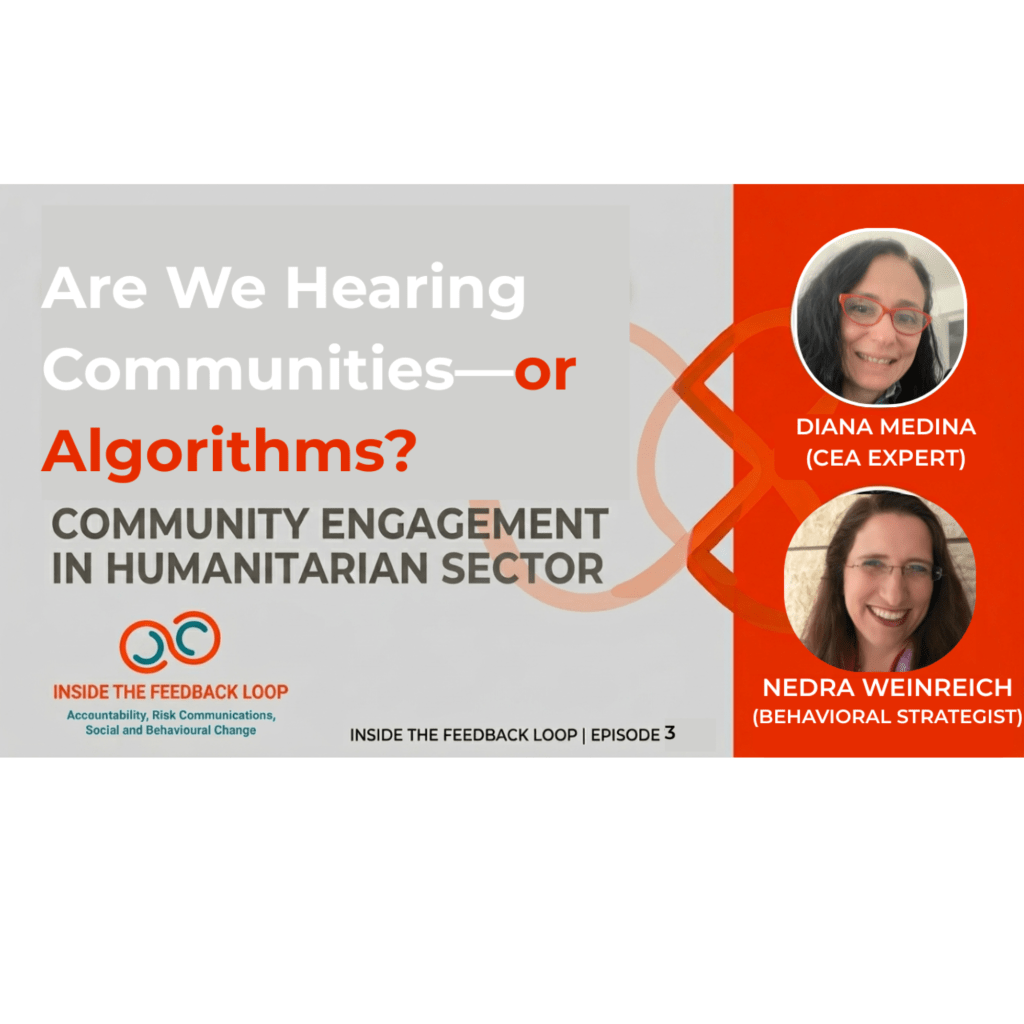
In this episode of Inside the Feedback Loop, Nedra Kline Weinreich joins Diana Medina to explore an increasingly important challenge in humanitarian and development research: what happens when AI-generated responses begin contaminating online surveys and digital data collection.
As organisations increasingly rely on digital tools for rapid assessments, behavioural research, and community feedback, questions around data quality, verification, and accountability are becoming more urgent. Nedra shares her firsthand experience managing an online survey that received a significant number of bot-generated responses — and the lessons this revealed about trust, research design, and the evolving digital landscape.
Together, the conversation explores:
- How AI-generated survey responses were detected
- Warning signs researchers should watch for
- Risks for humanitarian and behavioural research
- Practical safeguards to improve data quality
- The balance between embracing innovation and protecting accountability
- Why human judgement remains essential in AI-supported research
This episode is particularly relevant for professionals working in humanitarian response, public health, community engagement, Accountability to Affected Populations (AAP), Social and Behavioural Change (SBC), monitoring and evaluation, and digital research.
Because stronger feedback loops depend not only on better tools — but on better questions.
Useful resource: https://publichealth.jmir.org/2025/1/e76622
#CommunityEngagement #AAP #SBC #Humanitarian #Research #ArtificialIntelligence #BehaviourChange #DigitalResearch #DataQuality #Accountability #Localization #InsideTheFeedbackLoop


Leave a Reply