If people can speak but cannot influence the decision, are we really talking about participation?
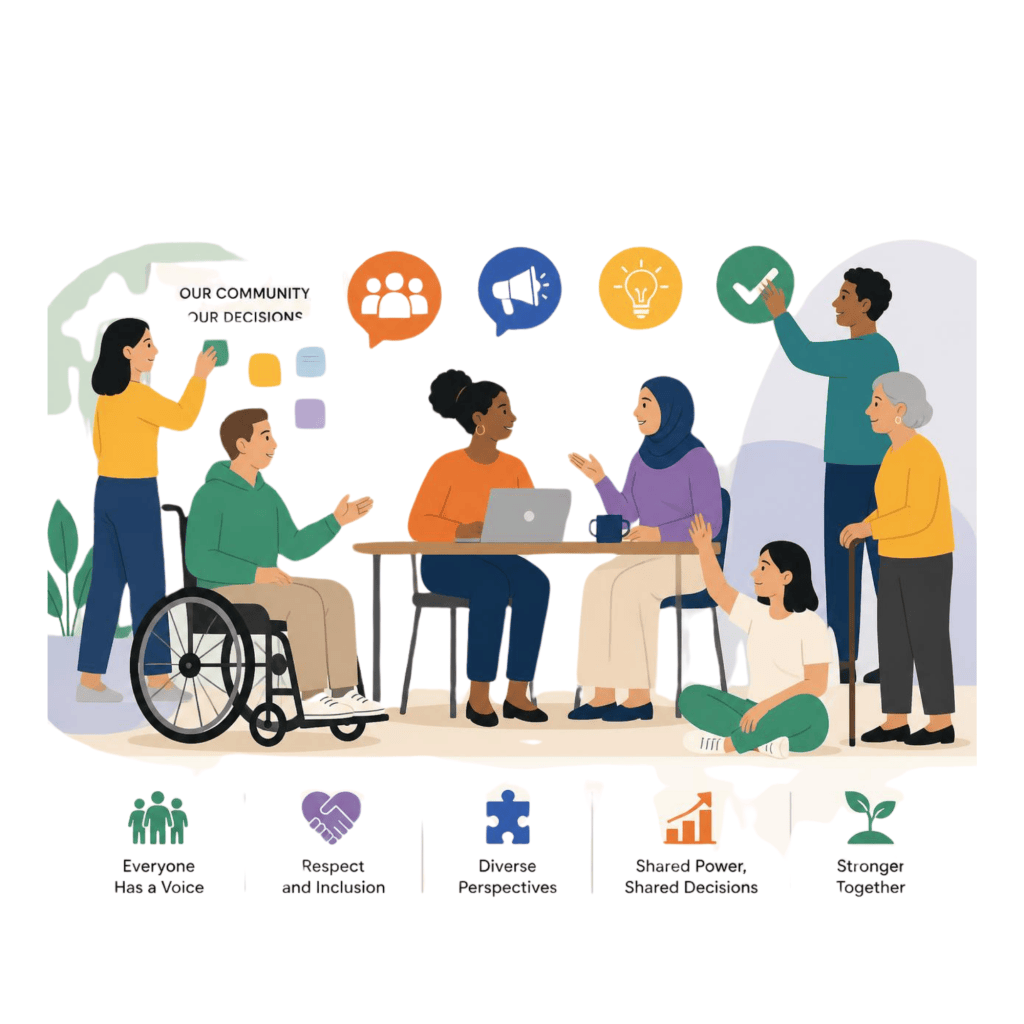
We love the language of participation.
It is everywhere.
Participation appears in our strategies, proposals, logframes, assessments, evaluations and donor reports. We consult communities, hold focus groups, establish feedback mechanisms and proudly report the number of people who were “engaged”.
And yet, I sometimes wonder whether we have made participation too easy.
Because there is a version of participation that asks very little of us.
We ask people what they think. We listen. We take notes. We analyse the findings. And then we go back to doing what we had already planned.
We call it participation.
I think we should call it something else.
Consultation.
There is nothing inherently wrong with consultation. Sometimes we genuinely need to understand people’s perspectives before making a decision. The problem starts when we confuse being asked with having influence.
And this matters because if we are serious about localisation, we need to have a much more uncomfortable conversation about power.
Participation without power is a very polite illusion
Let’s imagine a programme team has already decided the budget, the geographical areas, the activities, the targeting criteria and the indicators.
Then they organise community consultations.
People are invited to share their priorities. The team listens carefully. Perhaps some suggestions are incorporated around the edges.
And afterwards, the organisation reports:
“Communities were meaningfully consulted in programme design.”
Were they?
Maybe.
But I think we should ask a harder question:
What could communities actually change?
If the answer is “very little”, then the problem is not that the consultation was poorly facilitated. The problem is that the decision-making architecture was never designed to allow meaningful influence.
This is why I see meaningful participation as fundamentally a question of power.
Not power in the abstract, but power in the everyday decisions that shape a programme.
Who gets to define the problem? Whose understanding of the situation becomes the starting point? Who decides what is a priority? Who can challenge an assumption? Who can ask for a programme to change? And, perhaps most importantly, who has the authority to say:
“No. This isn’t working for us.”
Those are participation questions.
They are also localisation questions.
We cannot talk about localisation without talking about communities
The localisation conversation has rightly focused on the unequal distribution of power between international and local organisations.
We talk about shifting funding, strengthening local leadership and changing partnership models. We talk about capacity, decision-making and locally led response.
All of this is necessary.
But I think we sometimes stop the conversation one level too early.
Because localisation is not only about shifting power from international organisations to local organisations.
It should also be about shifting power towards people and communities affected by the decisions we make.
Otherwise, we risk creating a strange version of localisation where an international organisation transfers implementation to a national organisation, while both organisations continue making decisions for communities.
The logos may change. The partnership agreement may change. The people managing the programme may change.
But the fundamental relationship with communities remains exactly the same.
That isn’t the transformation we should be aiming for.
For me, localisation should ultimately be about proximity to power, not simply proximity to implementation.
And meaningful participation gives us one way of asking whether that shift is actually happening.
The uncomfortable question: who gets to decide?
The Core Humanitarian Standard gives us an important reference point here.
The 2024 CHS puts stronger emphasis on the primary role of people and communities in finding solutions to the crises they face, as well as on addressing power imbalances through equitable and collaborative relationships.
That is a much more ambitious proposition than “we consulted communities”.
It asks us to rethink the relationship itself.
The IFRC’s approach to CEA makes a similar point: communities should be treated as equal partners, with their opinions used to design and guide work and with control handed over to communities as much as possible.
I think this is where the real test begins.
Not with the question:
“Did we engage?”
But:
“What did people have the power to influence?”
Once we ask that question, participation becomes much less comfortable.
We have to look at how decisions are made inside organisations. We have to confront the limits created by budgets, donor requirements, organisational procedures and risk management. We have to ask how much flexibility actually exists once a proposal has been approved and implementation has started.
And we have to acknowledge something that is rarely said explicitly:
sometimes the system is designed in a way that makes meaningful participation almost impossible.
No amount of better facilitation can solve that.
You cannot meaningfully participate in a decision that has already been made.
So, how do we know if participation is meaningful?
There is no single checklist that can tell us whether participation is meaningful.
It is something we need to examine throughout the way we work: who is involved, when they are involved, what they can influence, whose voices are missing, and what happens as a result.
One useful place to look is at what happens to people’s feedback.
A functioning feedback loop is not, by itself, proof of meaningful participation. But it can provide one practical test.
Imagine someone tells us that a service is not accessible. The organisation records the feedback, analyses it and includes it in a report. On paper, the organisation has listened.
But what happened next?
Did the information reach someone who could act on it? Was the programme adapted? Was the person who raised the concern told what happened?
If feedback can move from the community into the organisation, reach the people making decisions, influence what happens and then come back to the community as action or explanation, we have some evidence that people’s voices can influence the programme.
If the feedback stops at collection, something is missing.
But a feedback loop is only one part of the picture.
We also need to ask whether people were involved early enough to influence the decision in the first place. Whether different groups had a genuine opportunity to participate. Whether people understood what they were being asked to influence. Whether they had enough information to make an informed contribution. Whether the organisation was willing to reconsider its assumptions. And whether communities had any real ownership over the process or the outcome.
A beautifully designed feedback mechanism cannot compensate for a programme in which all the important decisions have already been made.
Equally, a community meeting can create genuine influence even without a formal feedback mechanism, if people have real power to shape the decisions being discussed and can see what their participation has contributed to.
This is why meaningful participation should not be reduced to a tool, a methodology or a single indicator.
It is better understood as a relationship between voice and power.
The question is not simply whether people had an opportunity to speak.
It is whether the conditions existed for their voice to matter.
Sometimes that will be visible through a feedback loop. Sometimes it will be visible in a programme changing direction because communities challenged the original approach. Sometimes it will be visible in local actors taking decisions without waiting for external approval. Sometimes it will be visible in an organisation being willing to acknowledge that its original assumptions were wrong.
And sometimes the most meaningful sign of participation is that a decision looks completely different from what the organisation would have designed on its own.
That is why I would resist the temptation to create another participation scorecard that allows us to say, “Yes, we did participation.”
The more useful question is harder:
Where, in this process, did people actually have influence—and what evidence do we have that it mattered?
That is the question that takes us beyond participation as an activity and towards participation as a shift in power.
But who exactly is “the community”?
There is another uncomfortable issue.
We often talk about “the community” as if it were a single person with a single opinion.
It isn’t.
Communities have their own power dynamics, inequalities and gatekeepers. Some people are accustomed to speaking in public; others may have very good reasons for remaining silent. Some people are easy for organisations to reach. Others may be much harder to hear.
A community meeting can therefore be participatory and still reproduce exclusion.
I have always found it useful to ask a deceptively simple question:
Who is missing?
Not only who attended the meeting, but who was unable—or unwilling—to be there.
Who did we assume could speak on behalf of everyone else? Whose experience was treated as representative? Whose knowledge was considered credible?
Sometimes the person who is easiest for us to reach is not the person whose perspective we most need.
Sometimes the community leader who gives us access is not the person who represents everyone.
And sometimes the people most affected by a decision are precisely those least able to participate in the process we have designed.
This is why meaningful participation requires more than creating opportunities to speak. It requires us to understand whose voice carries weight, whose voice is missing, and why.
Otherwise, participation can become another mechanism through which existing power is reproduced.
Participation also costs something
There is something else we rarely acknowledge.
We ask a lot from people in the name of participation.
We ask them to attend meetings, answer surveys, join focus groups, explain their priorities, tell their stories, give feedback and validate our findings.
Sometimes we ask them to do it repeatedly, for multiple organisations.
Meanwhile, they are dealing with the crisis itself.
So perhaps we should ask a different question:
What does participation cost the people we are asking to participate?
Time is a cost. Travel is a cost. Childcare is a cost. Emotional labour is a cost. And, in some contexts, participation can carry real risks.
There is also another cost that is harder to measure: disappointment.
When people repeatedly tell organisations what they need and see little or nothing change, participation itself can become a source of frustration and distrust.
If participation creates better information for us but no meaningful value for them, we need to question whether the process is genuinely participatory—or simply extractive.
Meaningful participation should change us
This is perhaps the biggest shift I would like to see.
We tend to think about participation as something communities do.
They participate in our assessments. They participate in our consultations. They participate in our programmes.
But meaningful participation should also require organisations to participate differently.
It should change how we make decisions.
It should challenge our assumptions.
It should create space for disagreement.
And sometimes it should result in us admitting:
“We got this wrong.”
That, to me, is a sign of a healthy accountability culture.
Not that an organisation gets everything right.
But that it has built enough trust and flexibility to recognise when it is wrong—and enough accountability to do something about it.
Perhaps this is one of the least discussed impacts of meaningful participation: it should change the organisation as well as the programme.
If we come out of every consultation reassured that our original plan was correct, we might need to ask whether we were really listening.
So, what does meaningful participation actually require?
I don’t think there is one perfect model.
The level and form of participation will always depend on the context, the decision, the risks and the people involved.
But there is a useful starting point.
Before inviting people to participate, we should know what we are genuinely prepared to put on the table.
If there is no decision they can influence, we should be honest about that.
If there are constraints, we should explain them.
If there is room for change, we should create the space for it.
And once people have shared their views, we should be prepared to show what happened next.
That sounds simple.
It isn’t.
Because being honest about the boundaries of participation can expose how little flexibility we have actually built into our programmes.
But perhaps that is exactly the conversation we need to have.
Rather than designing increasingly sophisticated ways of asking people what they think, perhaps we should spend more time asking ourselves what we are prepared to change because they told us.
Localisation should be felt, not just reported
We have become very good at reporting localisation.
We can count local partners. Track funding. Measure local leadership. Report capacity-strengthening activities.
These indicators matter.
But there is another measure of localisation that is harder to capture:
Can people feel that they have more influence over decisions that affect their lives?
Can they see that their knowledge matters?
Can they challenge an organisation?
Can they understand why a decision was made?
Can they see something change because of what they said?
Can local actors make decisions without constantly seeking approval from somewhere further away?
Can communities shape a response rather than simply participate in delivering it?
These questions are harder to measure.
Perhaps that is why we don’t ask them often enough.
But power is not only something that appears in a funding agreement or an organisational chart.
Power is experienced in decisions.
And if localisation is genuinely about changing power, then that experience matters.
From participation to partnership
Ultimately, I think we need to stop asking how to make people participate in our programmes.
The better question is:
How do we build programmes in which people have a legitimate role in shaping the decisions that affect them?
That is a different starting point.
It moves us from participation as an activity to participation as a way of working. From consultation to influence. From feedback collection to organisational change. From people being treated as recipients to people being recognised as partners.
And it changes the meaning of localisation too.
Localisation is not complete because implementation has moved closer to communities.
It is not complete because a local organisation has taken over delivery.
And it is certainly not complete because we have included the word “local” in our strategy.
Localisation becomes meaningful when power moves.
When people can influence decisions.
When local knowledge can challenge external assumptions.
When organisations have enough flexibility to respond.
When communities can see the consequences of their participation.
And when saying “this isn’t working” can actually lead to something being reconsidered.
That requires more than new tools or better consultation techniques.
It requires us to give up some control.
And that may be the hardest part.
Because meaningful participation is not about giving people a seat at our table.
It is about accepting that it is not always our table.
If we are serious about localisation, we have to be willing to let communities and local actors shape the table itself: what is discussed, what decisions are made, what resources are available, and ultimately what success looks like.
That means moving beyond the comforting idea that we are putting communities “at the centre”.
Perhaps they were never meant to be at the centre of our programmes.
They are meant to have a say in what those programmes become.
And if that changes our plans, our priorities, our timelines—or even our understanding of the problem—that is not a failure of participation.
That is participation working.
And perhaps that is the real test of localisation:
not whether power has been promised, but whether someone who previously had little of it can now use it to change a decision.


Leave a Reply