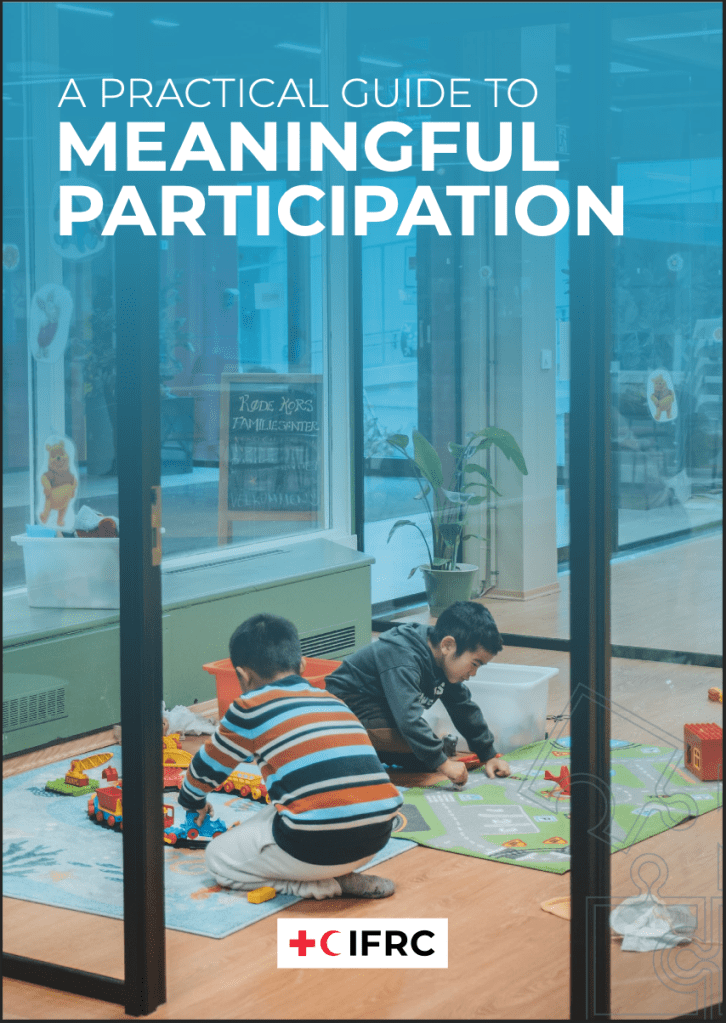
A practical guide to understanding and planning meaningful community participation in programmes and operations.
🔎 Tool Snapshot
Type: Practical Guide
Organisation: International Federation of Red Cross and Red Crescent Societies (IFRC)
Primary use: Programme and operations design support
Best for: Migration and displacement contexts
Use mode: Online and printable offline
Skill level needed: Medium
Languages: English
Data sensitivity level: Low
Data protection features: Not tool-based (guidance only)
Cost model: Free
Access type: Open access
Where to find it: https://communityengagementhub.org/wp-content/uploads/sites/2/2026/01/Meaningful-participation-practical-Guide-2025.pdf
Account required: No
🧩 Tool in one sentence
A practical guide that helps humanitarian teams understand what meaningful participation looks like in practice and how to design programmes that enable communities to genuinely influence decisions.
🎯 Primary accountability contribution
This tool most strongly supports:
- Meaningful participation planning
- Inclusion analysis
- Participation quality assessment
- Community-centred programme design
- Evidence-informed operational and programmatic decisions
📝 What this tool does (In practice)
This guide helps practitioners break down what “meaningful participation” actually looks like in real programme and operational settings. It translates participation from principle into practice by outlining levels, dimensions, and enabling conditions, and helps teams assess how participatory their approach really is.
The guide explores how different groups experience participation and highlights the importance of inclusion to ensure that participation processes do not unintentionally exclude certain voices.
It is particularly grounded in migration contexts, but the conceptual framework can be adapted more widely. Rather than offering recipes, the guide focuses on strengthening practitioner understanding and judgement, helping teams reflect on how participation is designed and implemented in their programmes.
✅ Strengths
- Easy to read and accessible explanation of meaningful participation concepts
- Breaks down a complex and often abstract topic into understandable components
- Helps demystify the idea that participation is overly complex or difficult to achieve
- Provides practical reflection questions that can inform programme design
- Includes a variety of case studies from different contexts, showing different levels and approaches to participation
- Strong emphasis on inclusion and representation of diverse groups
- Question-and-answer structure helps simplify concepts and can support training or workshop discussions
⚠️ Limitations & Watch-outs
- The guide is largely anchored in migration contexts in Europe and Central Asia, meaning that some adaptation may be needed for other contexts
- The document is relatively text-heavy, which can limit quick reference or rapid field use
- While the Q&A structure simplifies concepts, the overall design is not particularly user-friendly and may require facilitation in workshop settings
- The guide is not a step-by-step implementation manual and does not provide detailed operational guidance
- It introduces the importance of informed consent but does not provide concrete templates or tools for applying it in practice
- Available only in English, which may limit accessibility for some teams and local partners
🛡️ Data responsibility relevance
(Guide-level — not a data tool, but influences practice)
- Promotes awareness of informed consent: ✅
- Encourages inclusive participation safeguards: ✅
- Provides operational consent tools: ❌
- Requires programme-level data protocols: ✅
🚀 Quick pilot recommendation
Use this guide as a team reflection and planning tool rather than a standalone implementation manual.
Start by selecting one programme or activity and analysing its current level of participation using the dimensions presented in the guide. Keep the initial scope narrow and focus on testing small improvements that can strengthen participation.
The reflection questions can be used in workshop discussions with programme teams and partners. Beginning with simple participation approaches and gradually expanding engagement activities can help teams build confidence and learning over time.
The guide also points to several additional tools developed by the IFRC, which can support the operationalisation of participation approaches through the Community Engagement and Accountability Hub.
Where possible, teams should also consider how to measure the impact of participation from the start. While this can be challenging, IFRC has also developed complementary tools that can support this process.
📊 Practice alignment score (CHS & Localisation Lens)
Scale: Limited / Moderate / Strong / Very Strong
| Dimension | Alignment |
| Participation Depth Support | Very Strong |
| Accountability Practice Value | Strong |
| Inclusion & Representation Lens | Very Strong |
| Local Adaptability | Moderate |
| Operational Step-by-Step Support | Limited–Moderate |
| Capacity Strengthening Value | Strong |
Overall Practice Alignment:
Strong conceptual and planning tool — best used alongside operational participation tools.
⚙️ When this tool works best
This guide is particularly useful when:
- Teams want to strengthen their understanding of meaningful participation
- Programmes are in the design or planning phase
- Organisations want to reflect critically on how participation is currently implemented
- Teams are conducting internal learning or capacity-building workshops
- Practitioners need a conceptual framework to guide participation decisions
Because the guide focuses on reflection and analysis, it works best in team learning settings rather than as a rapid operational reference in the field.
⚠️ When it may be more challenging
The guide may require additional tools or facilitation when:
- Teams need step-by-step operational guidance for participation activities
- Field teams are looking for quick practical instructions
- Participation mechanisms need to be implemented rapidly in emergency contexts
- Programmes require concrete tools for measuring participation outcomes
In these situations, the guide is best used alongside practical implementation tools.
🔁 “Inside the Feedback Loop” insight
Meaningful participation is often presented as a principle in humanitarian policy, but in practice it depends heavily on how programmes are designed and how decisions are made.
One of the key contributions of this guide is that it helps practitioners move beyond symbolic participation and reflect on whether communities are genuinely influencing decisions. In this sense, meaningful participation is not simply about consultation — it is a critical component of accountability and trust between organisations and the communities they serve.
💡 Field Tip
Use the guide in team reflection sessions. Asking programme staff to analyse a real project using the participation dimensions can quickly reveal where participation is strong and where it remains largely symbolic.
⚠️ Common mistake when using this tool
Treating the guide as a conceptual document only and not using it to critically review real programme decisions.
The real value of the guide emerges when teams apply it to actual programme design choices, asking where communities are influencing decisions and where participation remains limited.
🧭 Practice takeaway
This guide is an excellent resource for understanding the different dimensions of meaningful participation in humanitarian programmes and emergency operations.
It helps simplify a concept that is often perceived as complex and highlights practical ways to think about inclusion and representation. While it does not provide step-by-step solutions, it clarifies key participation concepts and points practitioners to additional tools that can support implementation.
Used as a reflection and planning resource, the guide can significantly strengthen how teams design participation processes and ensure that community voices meaningfully inform humanitarian action.


Leave a Reply