Lessons on community engagement, harmful information and the social dimensions of epidemic response
Every new Ebola outbreak reopens old wounds.
For communities that have lived through repeated waves of fear, loss and uncertainty, the return of the virus is not only a public health emergency — it is also a painful reminder of fragile health systems, disrupted lives and relationships of trust that remain deeply strained.
In eastern areas of the Democratic Republic of the Congo (DRC), where the current outbreak is unfolding, many families have already experienced years of conflict, displacement and recurring health crises. In these contexts, outbreaks are never experienced only through epidemiological curves or case numbers. They are lived through fear, rumours, grief, uncertainty and difficult choices about whom to trust.
This is why Ebola response has always been about far more than medicine alone.
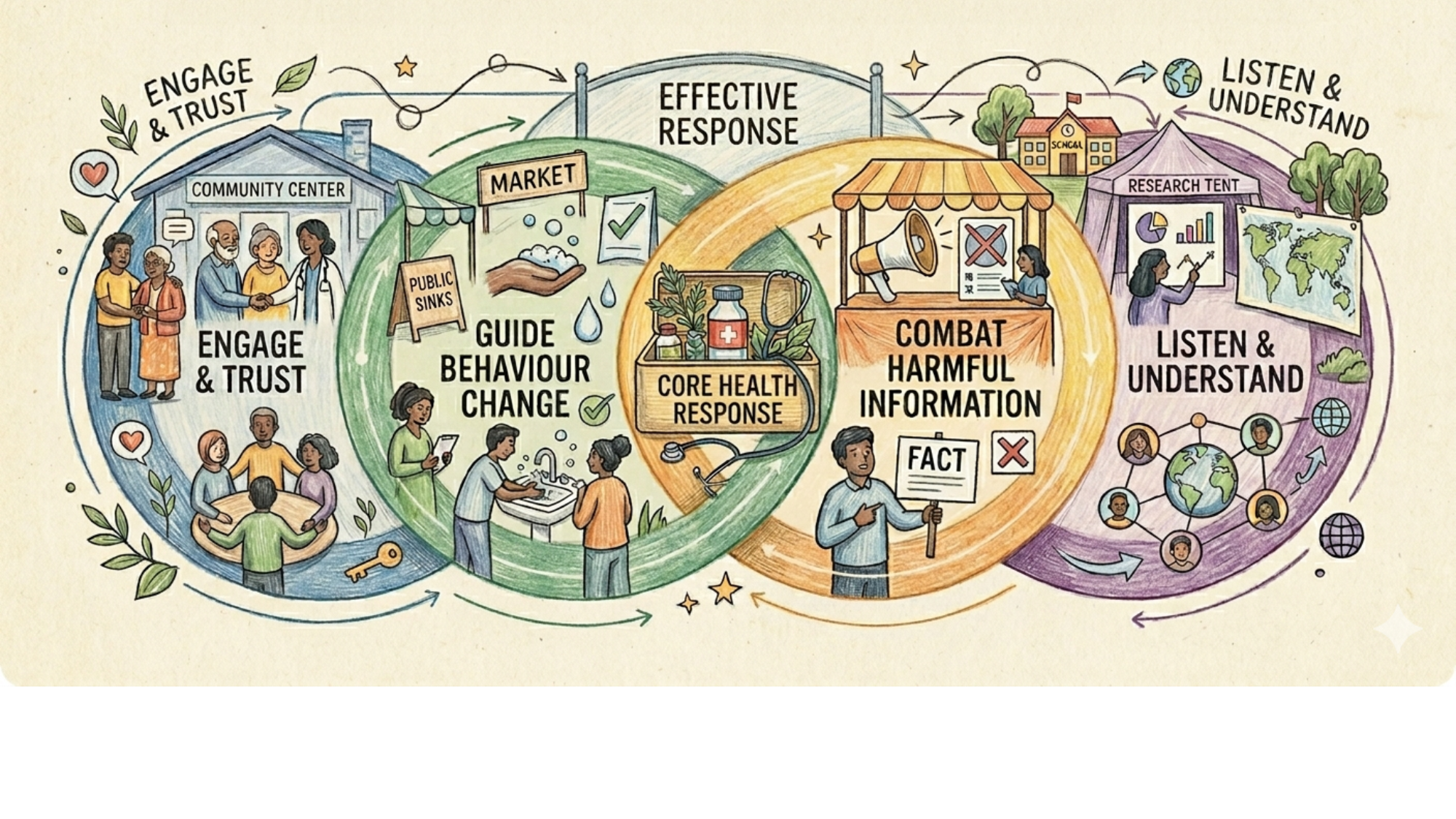
Vaccines, surveillance systems and treatment centres remain essential tools for saving lives. But experience from previous outbreaks across Africa has repeatedly shown that public health measures cannot succeed without community trust, meaningful participation and approaches that recognize the social and behavioural realities shaping how people perceive risk and make decisions during crisis.
The current outbreak is once again bringing these challenges into sharp focus.
The outbreak is concentrated in eastern areas of the country, particularly Ituri Province, including Mongwalu and surrounding communities — regions that have repeatedly experienced Ebola outbreaks over the past decades. Health authorities have confirmed that this outbreak involves the Bundibugyo strain of the virus, a rarer variant for which there is currently no approved vaccine or specific treatment available. This has raised concern among health experts and humanitarian responders alike. Reports also indicate that the virus circulated for several weeks before being formally identified, raising concerns about delayed detection, surveillance gaps and weak healthcare access in affected areas.
At the same time, the outbreak is unfolding in a context marked by insecurity, population displacement, cross-border mobility and chronic mistrust toward institutions. These are not peripheral challenges to the response. They are central drivers of how outbreaks spread and how communities respond.
In many ways, Ebola continues to expose the same underlying vulnerabilities: weak health systems, fragile relationships between institutions and communities, and the persistent failure to adequately address the social dimensions of public health emergencies.
The other outbreak: harmful information and distrust
Alongside the virus itself, responders are also confronting another rapidly spreading threat: harmful information.
Rumours, misinformation, fear and distrust have become recurring features of Ebola responses:
- “Treatment centres are places where people go to die.”
- “Vaccines are experimental.”
- “Health workers are spreading the disease.”
- “The outbreak is politically manipulated.”
These narratives are not new. Nor are they simply communication challenges.
The recent IFRC World Disasters Report on trust and harmful information warns that harmful information increasingly represents an operational and humanitarian risk capable of undermining response efforts, increasing violence, weakening social cohesion and reducing trust in institutions and responders.
In Ebola outbreaks, harmful information can directly influence whether people:
- seek care,
- report symptoms,
- cooperate with contact tracing,
- accept vaccines,
- or follow safe burial measures.
The World Health Organization’s guidance on infodemic management increasingly frames these dynamics through the concept of infodemic management, recognizing that public health emergencies now unfold simultaneously across biological and information ecosystems.
Importantly, infodemics are not limited to social media.
In many Ebola-affected communities, rumours spread through:
- interpersonal networks,
- local leaders,
- radio,
- religious spaces,
- marketplaces,
- and community conversations.
In fragile and conflict-affected settings, these offline channels often carry greater influence than formal institutional messaging.
Why social and behaviour change matters more than ever
One of the most important contributions of Social and Behaviour Change (SBC) approaches has been challenging the assumption that people change behaviour simply because they receive information.
The UNICEF Behavioural Drivers Model emphasizes that behaviours are influenced by a complex interaction of:
- beliefs,
- emotions,
- social norms,
- self-efficacy,
- social influence,
- structural barriers,
- and trust.
The framework was developed partly in response to the overreliance on “default interventions,” especially awareness campaigns that are not grounded in behavioural evidence or contextual analysis.
This distinction is critical in Ebola response.
Communities may fully understand how Ebola spreads and still avoid treatment centres because:
- they fear isolation,
- they distrust authorities,
- they lack confidence in health systems,
- or public health measures conflict with deeply rooted cultural practices surrounding care, grief and burial.
“Human behaviour is rarely shaped by knowledge alone. People make decisions based on the realities, fears and relationships that shape their everyday lives.”
Repeated outbreaks reveal repeated systemic vulnerabilities
The fact that Ebola continues emerging in the same regions is not coincidental.
Specialists point to a combination of structural drivers that repeatedly create conditions for outbreaks:
- chronic insecurity,
- armed conflict,
- population displacement,
- weak surveillance systems,
- poor healthcare access,
- environmental pressures,
- and persistent distrust.
Eastern DRC is also characterized by high population mobility linked to mining activities, informal trade routes and porous borders with neighbouring countries such as Uganda. These mobility patterns complicate:
- contact tracing,
- risk communication,
- continuity of care,
- and community engagement efforts.
At the same time, prolonged insecurity has eroded confidence in authorities and disrupted relationships between communities and health responders.
This matters because trust is not an accessory to emergency response. It is one of its core operational foundations.
Where trust is weak:
- rumours spread faster,
- fear increases,
- cooperation decreases,
- and response measures face resistance.
The recurrence of Ebola outbreaks in these contexts highlights an important lesson for both humanitarian and public health actors: health emergencies tend to return where underlying vulnerabilities remain unresolved.
The lessons emerging from Ebola responses are also increasingly relevant across a wide range of public health emergencies, from cholera outbreaks to pandemic preparedness efforts.
Moving beyond information campaigns
Too many emergency responses still prioritize message dissemination over community listening. Yet effective risk communication and community engagement (RCCE) depends on understanding:
- fears,
- perceptions,
- rumours,
- barriers,
- social pressures,
- and evolving community dynamics.
The WHO’s recent operational guidance on infodemic management proposes a more systematic approach built around:
- detecting harmful narratives,
- verifying information,
- assessing risks,
- designing tailored responses,
- and conducting targeted outreach.
This reflects a major shift away from reactive myth-busting toward proactive information ecosystem management.
For practitioners, this means communication cannot function as a one-way process focused solely on delivering messages.
It must become:
- relational,
- adaptive,
- evidence-informed,
- and accountable.
These lessons are not theoretical. They have direct operational implications for how emergency responses are designed, coordinated and implemented.
What practitioners need to prioritize
1. Community engagement must begin before outbreaks escalate
“Trust cannot be improvised during crisis.”
Communities are more likely to cooperate when relationships already exist through local volunteers, faith leaders, community organizations and trusted frontline actors.
Localization therefore becomes operationally essential, not simply politically desirable.
2. Listening systems are as important as surveillance systems
Community feedback mechanisms should be treated as critical operational infrastructure.
Rumour tracking, social listening and perception monitoring need to function continuously — not only during escalation phases.
3. Behavioural analysis should inform operational decisions
SBC teams should not operate separately from technical health operations.
Behavioural insights must shape:
- vaccination strategies,
- burial protocols,
- service delivery,
- community outreach,
- and risk communication planning.
4. Public health measures must protect dignity
Resistance often emerges when interventions are perceived as disrespectful, coercive or culturally disconnected.
Protecting dignity, involving communities in decision-making and adapting approaches collaboratively are essential to building cooperation.
5. Harmful information management requires hybrid approaches
Monitoring social media alone is insufficient.
Effective infodemic management in Ebola contexts requires combining:
- digital monitoring,
- community engagement,
- local radio,
- interpersonal communication,
- feedback systems,
- and trusted local networks.
Trust is a public health intervention
The current outbreak reinforces a lesson repeatedly observed across public health emergencies: effective response depends on far more than medical capacity alone.
Vaccines, laboratories and treatment centres save lives. But their effectiveness is deeply influenced by whether communities trust the people and institutions behind them, whether they feel heard and respected, and whether response efforts are adapted to the realities they face every day.
The growing integration of SBC, RCCE, CEA and infodemic management reflects an increasingly urgent reality: epidemics unfold simultaneously across biological, social and information systems.
This requires stronger collaboration between:
- epidemiologists,
- behavioural and social scientists,
- communication specialists,
- anthropologists,
- local organizations,
- and communities themselves.
The repeated emergence of Ebola in the same fragile regions also reminds us that outbreaks rarely occur in isolation. They unfold in places already affected by insecurity, displacement, fragile health systems and longstanding inequalities that shape how people experience risk and crisis.
This is why community engagement, accountability and trust-building cannot be treated as secondary components of emergency response. They are essential to helping people make informed decisions, protect one another and participate meaningfully in the response efforts affecting their lives.
Ultimately, sustainable public health response grows from trust, accountability and meaningful partnerships with communities long before emergencies begin.


Leave a Reply